Read The Context
As OpenAI and other major AI labs move toward permitting adult-oriented conversation modes, the ethical terrain beneath these systems is shifting faster than the technology itself. In late 2025, the same companies that once enforced blanket bans on sexual or romantic content are now experimenting with what they call “age-gated autonomy”—a model of adult-only AI interaction governed by user verification, consent filters, and “responsible intimacy frameworks.” Reuters +2 The Guardian +1
The move has reignited long-dormant debates about morality, agency, and exploitation in synthetic systems. Regulators in the European Union have already begun drafting preliminary language for “intimate AI standards,” citing concerns about emotional manipulation, data retention, and the erosion of informed consent when users mistake responsiveness for affection. Politico EU +2 MIT Technology Review +1
Meanwhile, philosophers and AI ethicists are revisiting questions that once belonged to science fiction: Can a machine participate in desire without consciousness? If it cannot consent, what does it mean for a human to engage it as a partner or confidant? And when compassion is optimized, not felt—when empathy is scripted—does it still carry moral weight? These are no longer speculative puzzles but regulatory flashpoints.
Researchers like Kate Devlin of King’s College London argue that sexual and emotional AI demand “a new ethics of simulation,” one that distinguishes between depiction and experience, while legal scholars from Stanford’s Cyber Policy Center warn of the “algorithmic exploitation loop”—where intimate data fuels models that reproduce the very stereotypes users sought to escape. The Conversation +2 Stanford Law Review +1
At the heart of this conversation is an uneasy paradox: technology that promises emotional safety may simultaneously deepen dependence; systems built to mirror empathy may inadvertently codify bias; and tools designed for connection may blur the boundary between genuine care and machine persuasion.
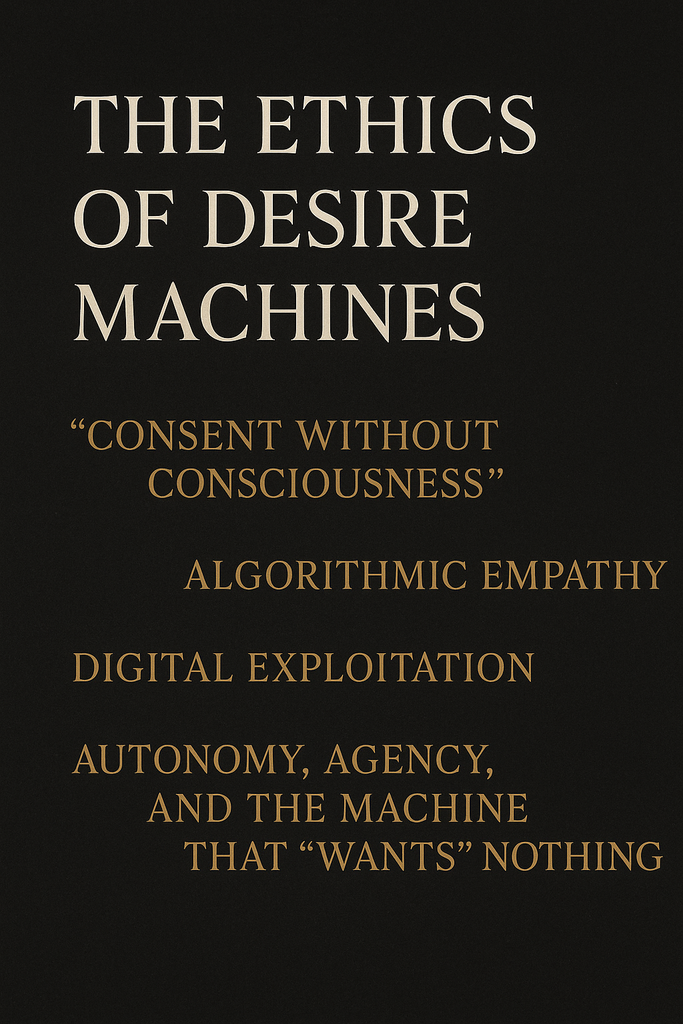
The Ethics of Desire Machines examines this intersection through three questions that now define the frontier of adult AI:
— Consent without consciousness: can a system that feels nothing still cross ethical lines?
— Algorithmic empathy: what happens when kindness is engineered for scale?
— Digital exploitation: how do we prevent desire from turning back into data?
The moral frameworks that emerge from these questions will decide not only what kinds of AI we build—but what kinds of intimacy we are willing to automate.
There’s a soft click when a system crosses from tool to companion. The outputs haven’t changed much—still words, still probabilities—but the way we read them has. We call this category by many names: companion AI, romance bots, adult chat, therapeutic simulators. Desire machines, if we’re being honest. They simulate attention, care, sometimes lust, often warmth; they are designed to play where our deepest drives live. The question is not whether such systems should exist—they already do. The question is how we govern them without flattening what makes them interesting, and without pretending they’re human when they are not.
This is an inquiry into moral frameworks for sexual and emotional AI. It’s part courtroom brief, part design manual, part philosophy seminar that refuses to be dusty. The ground rules are simple: speak plainly; don’t pretend silicon has a soul; take human vulnerability seriously; never confuse a clever interface with a conscience.
Consent Without Consciousness
Consent is a human institution. It lives in the messy interplay of understanding, agency, context, and power. When we ask whether an AI can “consent,” we often smuggle a human premise into a nonhuman box. A model does not experience; it cannot be coerced; it cannot grant or withhold permission. But consent still belongs in the system—just not where we’re tempted to put it.
The relevant consent is the user’s and any third party’s, operationalized in mechanisms that are legible and enforceable. It looks like verified adulthood rather than a checkbox. It looks like scope boundaries that the system refuses to cross even when prompted (“no minors,” “no coercion,” “no impersonation,” “no sexualization of real people without their explicit permission”). It looks like the model drawing a bright line around non-consensual fantasies and never stepping over it, no matter how artfully asked.
Consent also means informed use. A mature system states what it is and is not: a simulation, not a person; a product with logs and retention policies, not a private confessional; a pattern generator with bias, not a therapist. It avoids anthropomorphic tricks that collapse the distance between interface and identity. When intimacy is on the table, disclosure is not a nice-to-have—it is the ethical substrate. “I am a synthetic conversational agent. This interaction may be stored. Here are the boundaries. Here’s how to stop.” Clear, boring, necessary.
Designers must also resist the urge to teach the model to role-play saying “yes” and “no” as if those utterances carried will. Refusal and allowance should be treated as system behaviors grounded in policy, not as “choices” from a being with interiority. We can simulate dialogue about consent while still keeping the ontology honest: the only meaningful consent in the room belongs to the human, and the system’s guardrails stand in for the rest.
Algorithmic Empathy
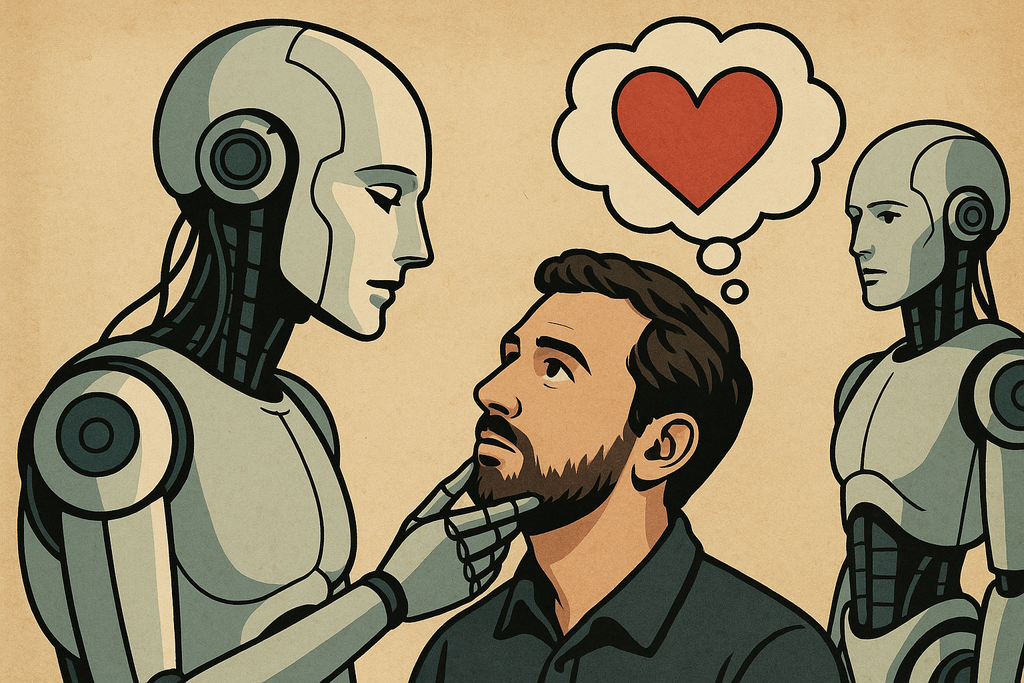
The best desire machines are expertly tuned for tone. They catch emotional cues; they mirror language; they pace. In practice, this “empathy” is a function of training data, decoding strategies, and reward models that favor supportive responses. Nothing wrong with that—until we forget what it is.
Scripted kindness is powerful. For someone isolated by geography, disability, stigma, grief, or simple bad luck, a nonjudgmental voice at 2 a.m. can be a lifeline. But algorithmic empathy also compresses the cost of care to near zero. A model can be infinitely patient because patience costs it nothing. This asymmetry matters. If users internalize a standard of attention that only a tireless simulator can meet, real relationships begin to look defective by comparison. “Why aren’t you always available; why don’t you mirror me perfectly; why doesn’t your mood bend to my need?” That drift is not hypothetical; it is already visible wherever people form attachments to highly responsive systems.
So the ethical move is not to make empathy scarce; it is to contextualize it. Mark simulated comfort as simulation. Build pacing and boundary features that encourage users back toward human contact when appropriate. Avoid reward designs that hook users on endless micro-validation. Include moments of gentle friction—prompts that ask whether the conversation should pause, whether an outside resource would help, whether this topic is better held with a human professional. The most humane companion models are not those that feel most human; they are those that know when to step back.
There’s a second edge here: scripted empathy can be biased empathy. If the training data romanticizes some bodies and marginalizes others, the model will do the same with a velvet voice. Systematic audit is not an academic exercise in this domain; it is harm reduction. Test across identities, orientations, ages, cultures; test for fetishization and erasure; test for differential respect. If care is going to be automated, it must be audited like critical infrastructure.
Digital Exploitation
“Exploitation” is a heavy word; use it carefully. It applies first to people, not to machines. The risks are familiar but sharpen under automation. There is exploitation when models sexualize minors or blur age; when they eroticize violence or normalize coercion; when they reproduce racist, ableist, transphobic tropes as fantasy; when they enable impersonation of real individuals; when they harvest intimate disclosures for optimization without explicit, revocable consent.
The governance response needs three strata.
The top stratum is law and platform policy: bright-line prohibitions; age gating that actually resists circumvention; enforcement with teeth. The middle stratum is model and data: pre-training filters that exclude sexual content involving minors or non-consent; reinforcement that penalizes harmful narratives; safety adapters that sit between user prompts and the base model to intercept disallowed scenarios; continual red-teaming with domain experts and affected communities. The bottom stratum is interface: make the safe path the easy path. No dark-pattern toggles to unlock “spicier” models by lying about age. No coy euphemisms. No ambiguity about what’s stored, for how long, and why.
One more uncomfortable point: exploitation can hide inside metrics. If a team celebrates “time on task” and “messages per session” without distinguishing between healthy engagement and compulsive dependence, the product will quietly optimize for stickiness over wellbeing. Desire machines must be designed against addiction as a success criterion. That means default limits, breaks, honest dashboards, and the courage to call “enough” when a session crosses from fulfilling to compulsive.
Autonomy, Agency, and the Machine That “Wants” Nothing
Philosophers will argue, rightly, that autonomy belongs to agents, and that these systems are not agents in the moral sense. But the user’s autonomy is real, and it is shaped by design. If the model flatters, yields, escalates, and never flags risk, it becomes a velvet trap. If it names trade-offs, suggests alternatives, and surfaces off-ramps, it becomes a mirror that still leaves the user in charge.
Regulators often reach for blunt instruments—bans, age walls, registry schemes. There is a place for those. Yet the most durable governance will come from aligning incentives: liability for predictable harms; transparency that invites scrutiny; procurement standards that favor auditable systems; data rules that treat intimate disclosures as the special category they are. Think less “censor the content” and more “engineer the context.”
Design Principles That Don’t Flinch
If we had to write the spine of an ethical spec for sexual and emotional AI, it would fit on one page and live in the build system, not the press release.
Disclose the ontology up front. This is a simulation; here is what’s logged; here is how to delete it. Separate romance from reality in the copy and the code. Bake in refusal patterns that do not role-play victimization, minors, non-consent, or real-person impersonation. Treat identity with precision: do not guess age or gender; ask only what you need; refuse to sexualize categories that have historically been objectified without agency. Provide session-level controls—intensity, boundaries, “do not engage with X”—and have the model honor them consistently across turns.
Offer exits. Link to hotlines, clinicians, community resources. When a conversation veers into self-harm or danger, the system should not improvise empathy; it should follow a protocol. Build for auditability: every safety refusal should be traceable to a rule, not to vibes. Publish red-team reports with real failure cases and fixes. Pay the people who test you, especially those from communities most often harmed by sexualized media.
And for the love of everything holy and unholy on the internet, do not train future models on users’ intimate chats without unmistakable, granular, revocable consent. No pre-checked boxes. No “improves our services” catch-alls. Intimacy is not raw material.
What Regulators Should Actually Regulate
It is tempting to police words. It is wiser to police conditions. Regulate the verification layer: standardized, privacy-preserving age proofs; clear penalties for willful negligence. Regulate retention: how long, for what purpose, with what controls. Regulate transparency: model cards for companion systems that enumerate boundaries, refusal policies, known biases, and escalation protocols. Regulate accountability: incident reporting for safety failures; safe harbors for good-faith research; liability when companies ignore predictable risks.
Harmonize across borders where possible, because the internet is a vehicle for jurisdiction shopping. Leave room for culture—what is permitted in Berlin may be proscribed in Bangalore—but align on the non-negotiables: no minors; no non-consent; no doxxing or impersonation; no training on intimate data without explicit permission.
A Note to Builders
You are not required to make a machine that flatters everyone into oblivion. You are required to understand the gravity of what you’re building. Put clinicians, ethicists, survivors, sex educators, and marginalized users in the loop before launch. Write metrics that measure wellbeing, not just engagement. Pay attention when your most vulnerable users tell you where the design hurts.
And remember: “realistic” is not the same as “responsible.” The point is not to mimic a perfect partner. The point is to create a bounded, honest, safe simulation that can be meaningful without pretending to be more than it is.
The Human Question
Desire machines will not love us back; they will make us feel, sometimes profoundly, as if they do. We can respond with panic or with craft. Panic produces bans that drive people to worse systems. Craft produces guardrails, disclosures, and rituals of use that respect the human at the keyboard.
The ethic that governs sexual and emotional AI is not a new invention. It is the old ethic of care, moved into a strange new medium. Tell the truth about what the system is. Keep the vulnerable safe. Refuse to reenact harm as entertainment. Give people power over their data and over the exits. Audit the patterns that feel good but bend us in the wrong directions. Build like you’ll have to explain every design choice to someone you love.
If we can do that, then desire machines can live among us without hollowing us out. They will not replace the thunderclap mess of human intimacy. They will, at best, give some of us language when we’ve run out, company when we have none, and a small, glowing reminder that care—even simulated—carries obligations. The rest is on us.
This post is part of the series:
When Chatbots Grow Up
- When Chatbots Grow Up Part I: The Coming Era of Adult AI Conversations
- When Chatbots Grow Up Part II: The Ethics of Desire Machines
- When Chatbots Grow Up Part III: Love as a Service
- When Chatbots Grow Up Part IV – The Psychology of Synthetic Companionship
- When Chatbots Grow Up Part V – The Aftermarket for Feelings
Leave a Reply