
PART I. THE PRODUCTIZATION OF CINEMA
How Movies Stopped Being Movies
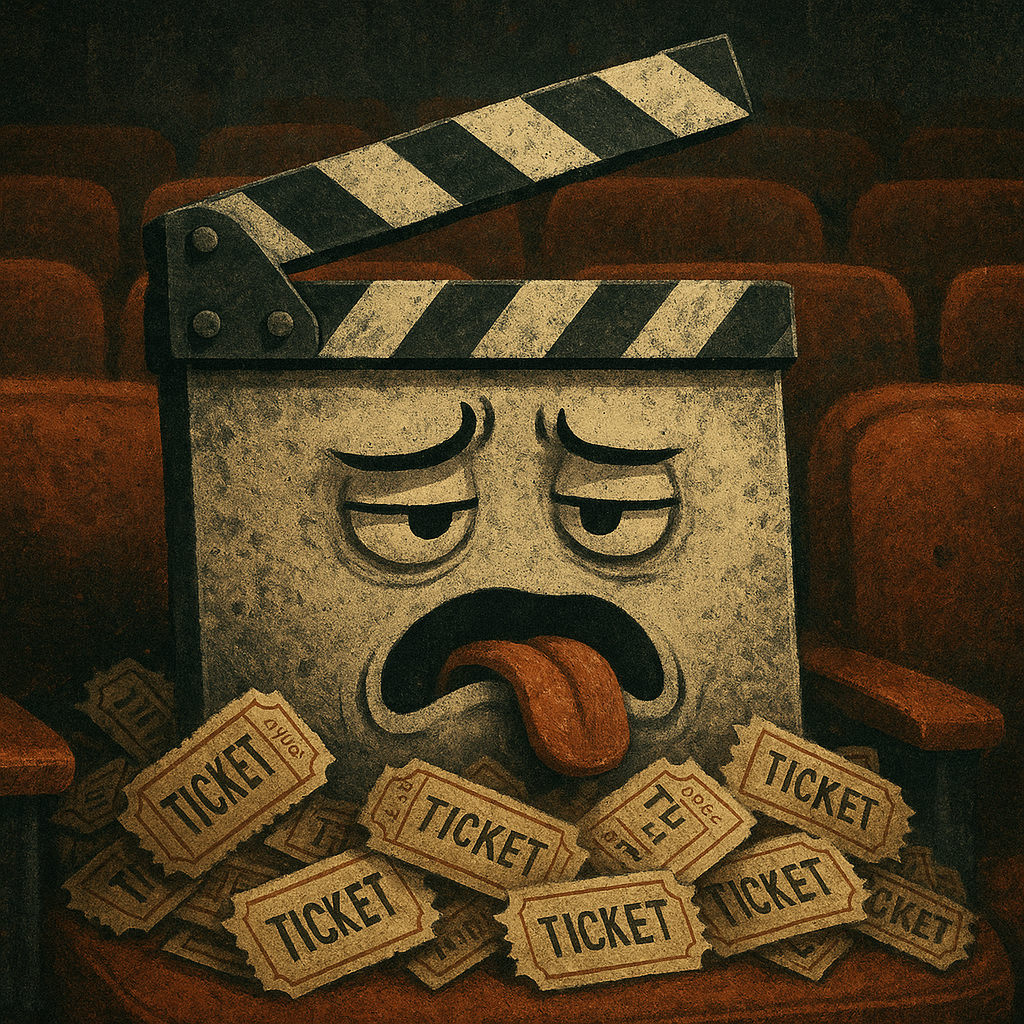
Mainstream cinema is struggling because major studios largely stopped making films and started manufacturing products. What used to be a risky, expressive art form has been replaced by a production-line mentality: safe beats, proven IP, and algorithms that optimize for predictability rather than surprise. The result is movies that feel engineered to hit box-office metrics instead of to move or challenge viewers.
Studio decision-making now privileges franchises, sequels, and international-market formulas. Test-screening data and marketing imperatives override singular artistic vision. Visual spectacle is prioritized over character and story. Writers and directors are constrained by franchise bibles, producers’ playbooks, and a short-term focus on return on investment, so originality is weeded out long before a film reaches theaters.
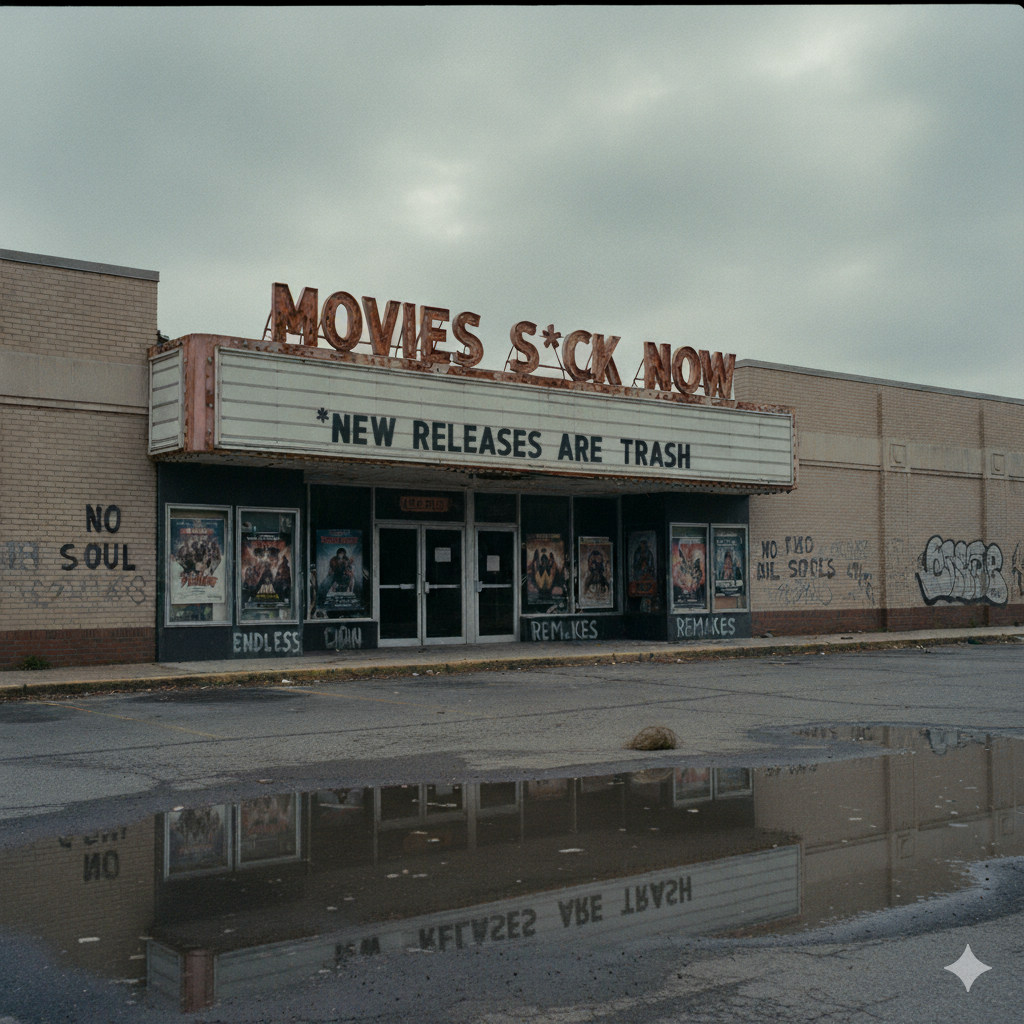
The consequence is a steady stream of interchangeable blockbusters that flatter spreadsheets more than audiences’ imaginations. That doesn’t mean good films are impossible—independent and international filmmakers still show what cinema can be—but understanding how commercialization warped the mainstream helps explain why so many new releases feel hollow and forgettable.
To understand how we arrived here, we have to look at:
- How corporate consolidation rewired power.
- How shareholder pressure reshaped creative decisions.
- How sequels and IP became financial instruments.
- How marketing and metrics now dictate story shape.
- How pipeline production stamped out surprise.
This series will follow that arc. When you put the pieces together, you don’t just get “movies are worse now.” You get a map of how the system was redesigned to extract value first and tell stories second.
PART II. CONSOLIDATION AND CONTROL
From Studio Lots to Corporate Empires
The story of Hollywood’s consolidation is less a single event than a series of compounding choices. Studios that once operated as vertically integrated factories—owning production, distribution and exhibition—were legally split up mid-century, only to be folded back into sprawling media conglomerates decades later. That reversal didn’t happen by accident. It followed waves of corporate finance, the arrival of global broadcast and cable markets, and later the technology-enabled impulse to own as many content gateways as possible. Each merger rewired who calls the shots, and where profit is measured, so the culture of decision-making moved steadily from craft-driven rooms to quarterly-report boardrooms.
The high-profile acquisitions illustrate the scale of the shift. Sony bought Columbia Pictures in 1989 and used it as an entry into Hollywood’s intellectual property machine. Disney systematically acquired studios and catalogs over the 2000s and 2010s—Pixar (2006), Marvel (2009), Lucasfilm (2012) and major parts of 21st Century Fox (2019)—building a single house of brands. Comcast consolidated NBCUniversal in the 2010s; AT&T purchased Time Warner in 2018 before the assets eventually joined with Discovery; Amazon completed its purchase of MGM around 2022. Meanwhile Viacom and CBS reunited and rebranded. Each transaction concentrated rights, archives and distribution muscle under fewer financial umbrellas.
Consolidation altered incentives. When a studio becomes a division inside a multinational, responsibility for greenlights drifts toward finance teams and corporate strategy officers who prize predictability and return on capital. Films cease to be discrete bets and become entries in larger portfolios: a hit compensates for failures elsewhere, and the safest way to defend a portfolio is to favor concepts that conform to prior successes. That logic favors repeatable structures—recognizable characters, tested beats, and marketing hooks—because they lower the chance a title will miss the portfolio’s required return threshold.
Those fewer decision-makers also reshaped distribution. As ownership of theatrical chains, pay-TV channels and streaming services re-concentrated, releasing strategies became tools for corporate leverage rather than purely artistic considerations. Studios learned to coordinate premieres and windows to feed their other businesses: a film might be designed less for the cinema’s communal experience than to shore up a streamer’s subscription numbers or to syndicate across international partners. Films that don’t fit those commercial funnels are often delayed, re-edited for broader markets, or shelved entirely.
The consequences on creative labor are concrete and ongoing. Consolidated power compresses negotiation space for writers, directors and mid-level producers who previously relied on a competitive ecosystem of studios and independent financiers. Career paths shifted: risk-taking directors either became specialists for lower-budget indies or were recruited to work within franchise frameworks where creative flexibility is limited but job security can be higher. Production departments were rationalized; expertise became more modular and project-driven, which erodes institutional memory and makes it harder for ambitious, singular voices to push against the corporate grain.
Finally, the cultural ripple effects matter because films are both business and conversation. When economic structures prioritize scale and defensibility over idiosyncrasy, audiences receive fewer genuinely new narratives that feel rooted in a distinct perspective. That homogenization isn’t total—there are still moments of surprise and invention—but the gatekeepers to mass distribution have fewer incentives to gamble on them. Understanding consolidation helps explain not just why many new releases feel familiar, but why the space in which a daring, unexpected movie can reach a wide audience has narrowed.
PART III. SHAREHOLDERS, IP, AND THE MATH OF SAFETY
Why Risk Died in the Boardroom
Executives at public media companies live by a calendar that rewards steady, short-term performance. Quarterly earnings calls, analyst models, and sell-side reports turn a studio’s slate into a set of deliverables that must hit revenue and margin targets on a predictable schedule. When every release is measured against the next quarter’s numbers, risk-taking becomes an expensive luxury: unusual projects that take time to find an audience look like liabilities, not opportunities. Over time, that scheduling pressure reshapes what gets budgeted, what gets marketed hard, and what gets quietly shelved.
Compensation frameworks accelerate the caution. A large slice of an executive’s pay is often tied to share price or short-term financial metrics, and boards approve bonuses that reward immediate gains rather than slow-growing cultural value. The math is simple: if a greenlight that might pay off in five years threatens this year’s earnings volatility, it’s unlikely to survive the scrutiny of a compensation committee. Those incentives make the safe, immediately monetizable option the rational choice for anyone whose livelihood is measured by quarterly movement in the stock ticker.
Shareholder activism and analyst scrutiny add another layer. Institutional investors and activist funds push for stronger returns and clearer, visible cash flows; they demand buybacks, divestitures, or tighter cost discipline when growth slows. In response, corporate leaders slice development slates into the smallest manageable units, seek third-party co-financing, and prioritize partnerships that guarantee near-term revenue. Creative leeway shrinks when financing is conditioned on minimizing downside rather than maximizing artistic upside.
Accounting realities and risk management compound the behavioral shift. Studios must account for production costs against expected revenues, and the specter of impairment charges or write-downs—an immediate, headline-grabbing hit to reported earnings—changes the stakes for executives who sign off on big bets. Rather than stewarding a handful of daring projects that may only slowly recoup their costs, management teams favor formats and deals that produce predictable amortization schedules, license windows, and ancillary income streams that ease the hit on the financial statements.
This is where intellectual property (IP) and sequels become essential. Studios stopped treating movies as one-off bets and started treating them like balance-sheet items. Intellectual property becomes a form of collateral: a recognizable title or character reduces the uncertainty around future cash flows, which makes it easier to raise outside capital. Lenders and co-financiers will underwrite a picture more readily if they can point to an existing audience and predictable downstream revenues, so the presence of IP materially changes the cost of capital for a project. That shift is quiet, technical, and enormously consequential—projects with bankable rights get cheaper financing and greater tolerance for budget overruns; ones without those rights often face punitive terms or no financing at all.
Sequels and extensions do more than reuse a logo on a poster. They compress the customer-acquisition problem: marketing can lean on recognition instead of invention, which lowers the marginal cost of each new title in a series. Studios also capture operational efficiencies across a franchise—shared production crews, recycled sets and VFX assets, franchise templates for scripts and shot lists—so per-film overhead falls. Those economies of scale are attractive to corporate accountants because they make the revenue curve less jagged: a steady, slightly smaller return across many sequels looks safer than one huge hit followed by long droughts.
Risk is managed with financial instruments as often as with creative decisions. Common levers include pre-sales to international distributors, tax-credit “soft money” in favorable jurisdictions, equity co-financing that shares upside and downside, and negative-pickup deals where a studio guarantees distribution after production is complete. These mechanisms reduce studio exposure up front, but they also steer production choices: foreign pre-buyers prefer clear, genre-driven pictures; tax credits favor location shooting and certain spending patterns; co-producers demand casting or story elements that fit their markets. In short, financing shapes the movie long before a script is locked.
For investors, a franchise isn’t just a movie; it’s a measurable asset class. Past entries create a history of cash flows, audience behavior, and marketing responsiveness that can be modeled with far greater confidence than a standalone original. That historical record reduces forecasting error: studios and analysts can estimate opening-week splits, ancillary revenue, and long-term tail earnings by mapping new installments against observable patterns from previous installments. The result is a smaller variance in return estimates, which makes capital allocation decisions cleaner and less speculative.
Franchises also open avenues for monetization that go well beyond ticket sales. When characters and worlds are familiar, licensees—apparel makers, toy companies, game developers—are more likely to sign deals and pay upfront guarantees. Investors view those contracts as distinct cash streams that can be anticipated and, in some cases, pledged or securitized. That multiplicity of revenue sources changes the risk profile: losses at the box office can be partially offset by steady licensing revenue or by exploitation of formats (animated series, themed experiences, localized spin-offs) that would be hard to pitch around an unknown property.
Operationally, franchises reduce friction. Casting attachments, crew hires, and negotiated vendor terms are easier because suppliers recognize the value of working on a branded title. Distribution partners—whether global theatrical chains or streaming platforms—are more willing to commit favorable windows and promotional support when they can bank on audience recognition. Those logistics shave weeks or months from scheduling uncertainty and lower the transaction costs that eat into margins. For financial managers, fewer moving parts mean fewer potential headline shocks that could trigger covenants or force distressed asset sales.
In other words: the system does not randomly prefer franchises. It is engineered to prefer them.
PART IV. THE NEW GODS: MERCH, METRICS, AND SURVEILLANCE
How Money and Data Now Edit the Movie
Merchandising is not an afterthought; it’s a parallel production line with its own deadlines, approval gates, and profit targets. Long before a picture hits cameras, manufacturers want definitive character sketches, scale drawings and color calls so they can build prototypes, test molding and secure shelf space. Those practical constraints feed back into the creative process: characters are sketched with simple, memorable silhouettes and removable accessories because those features translate cleanly into mass-produced toys and collectibles. Practical manufacturability—what designers call “toyetic” potential—can therefore shape costume choices, stunt choreography, even how often a character appears on screen.
Contracts around non-ticket revenue are another lever of influence. Studios often sell exclusive merchandising rights or guarantee minimum advances to licensees as part of financing packages. Those minimums reduce studio exposure but also give licensees veto-like clout over late design changes; once a mold is ordered or a retail buy is signed, it becomes costly to alter look or name. The result is early creative lock-in: story elements that might have been revised in post are frozen because third-party suppliers need certainty to meet production and shipping schedules.
Retail partnerships change the calendar of a film campaign. Major retail chains demand exclusives, co-branded product launches and synchronized promotional windows. To secure prime merchandising placement—end-cap displays, front-of-store events, online exclusives—studios will time premieres, toy ship dates and streaming debuts to match retail cycles such as holidays or back-to-school. That coordination sharpens revenue visibility, but it also compresses how and when a movie can be finished. A delayed VFX shot becomes more than a creative cost; it can disrupt a whole chain of consumer products already in motion.
Not all non-ticket revenue is tangible. Licensing plays extend into experiences and services: branded exhibitions, location-based attractions, streaming tie-ins that turn passive viewers into subscribers, and special-edition digital goods sold through game stores. These formats reward repeatability and recognizable motifs—logos, musical cues, catchphrases—because they make conversion easier. Creative teams are increasingly asked to think in modular pieces that can be isolated and repurposed across platforms: a funny line for a commercial, a brief action beat for a mobile game, an emblem that works as a theme-park badge.
Quality control and brand stewardship become battlegrounds when merchandising scales. Low-quality tie-ins can corrode goodwill and shorten a property’s profitable life, so studios deploy brand teams to police product standards, approve materials and enforce image guidelines. That policing is useful—protecting a film’s reputation—but it also narrows the palette of permissible experimentation. Risky visual choices, ambiguous character arcs or culturally specific humor are harder to justify when a hundred licensees will translate the idea into plastic, fabric, or code.
Meanwhile, data stopped being an occasional advisory memo and became an omnipresent collaborator. Editors now receive scene-level analytics alongside dailies: which ten-second beats lose viewers, where audiences rewind, and which visual motifs correlate with higher completion. Those signals travel back into the cutting room. The result isn’t always subtle: scenes that confuse viewers get shortened; ambiguous motives get spelled out; character moments that historically played as slow-building payoffs are rearranged to occur earlier. This isn’t mere tinkering. It changes authorship. Decisions once defended as aesthetic are now defensible because they moved a retention curve by three percentage points.
Streaming platforms and distributors use multiple, measurable engagement metrics, and each metric pushes creators in a different direction. A high “start” rate rewards striking first frames and flashy thumbnails; a high “completion” rate rewards clearer narrative propulsion and fewer tonal detours; a strong “next-episode” lift privileges cliffhangers and episode-end hooks. When teams optimize to those measurable goals, storytelling fragments into modules designed to perform against dashboards. The art becomes modular: beats that must function on their own for promotional clips, hooks that can be replayed as trailers, and set pieces that double as social clips ready to be shared in a feed.
Social listening has become a quiet co-writer. Real-time sentiment analysis flags lines, characters, or images that ignite conversation, and studios respond quickly. Riders of online controversy can prompt re-edits, added context, or even reshoots if the social signal threatens distribution windows or merchandising deals. Conversely, an unexpected viral reaction can shift marketing to emphasize an incidental supporting role, effectively rewriting a film’s public identity after principal photography has closed. These feedback loops accelerate the lifecycle of a project but also make narrative choices hostage to the momentary moods of an algorithmically amplified crowd.
Data is also reshaping casting and character design. Social metrics—search trends, follower engagement, demographic split of audiences—feed casting models. Producers increasingly evaluate talent through measurable online traction alongside auditions and chemistry tests. Costume and production design face similar scrutiny: simple silhouettes, distinctive color contrasts, and clear iconography photograph better at thumbnail scale and translate more reliably into merchandise. The invisible logic of discoverability nudges aesthetic choices toward legibility, often at the expense of texture and surprise.
The combined force of merchandising timelines and analytics dashboards means this: you can now watch the market edit the movie.
PART V. TESTING, TRAILERS, AND THE OPENING-WEEKEND MACHINE
How Selling the Movie Rewrites the Movie
Test screenings used to be a blunt instrument — a handful of people in a theater with comment cards — but they have evolved into a complex, semi-scientific process that can dictate creative decisions. Studios now recruit stratified panels that mirror targeted demographics, run multiple cut versions back-to-back, and use structured survey instruments to quantify reactions to pacing, character sympathy, and joke density. Those numbers don’t simply tell filmmakers “this scene landed”; they feed into decision gates that can prompt additional shooting, tonal smoothing, or even recasting. Over time, what began as guidance has hardened into formal checkpoints in many production timelines.
Beyond questionnaires, modern screenings often pair qualitative feedback with biometric and behavioral measurements. Eye-tracking maps where viewers look during key frames. Skin conductance and heart-rate variability register emotional spikes. Combined with timestamped survey responses, these signals let analysts identify the precise moment attention falls away or returns. Filmmakers who receive these layered reports confront a difficult calculus: honor instinct and ambiguity, or hew to the heat-map that shows the crowd disengaged at minute 27?
Social listening works on a broader, faster scale. Clips and trailers are seeded intentionally to observe which moments spark discussion, which phrases become memes, and which characters generate user-created content. Natural language processing tools aggregate millions of public posts and extract themes—praise, confusion, outrage—then quantify the intensity and trajectory of those reactions. That speed is useful for crisis control and campaign refinement, but it also privileges reactions that are loud rather than representative, and short attention spans over slow-burn appreciation.
Predictive models tie these inputs together. Machine-learning systems ingest dozens of variables — cast recognizability, genre mixes, release dates, historical box-office analogs, pre-release social sentiment, and test-screening scores — to produce probability distributions for opening weekend and long-tail revenue. These forecasts can be surprisingly granular, allocating marketing spend by geography and adjusting ad creatives mid-campaign. Yet the models are only as objective as their data: biases in the training set, overreliance on past patterns, and the omission of “cultural surprise” make them brittle when something truly novel enters the market.
Then there’s marketing itself. Studios now treat a release as a short, violent campaign to seize cultural attention rather than as the start of a slow conversation. Everything in marketing is designed to concentrate awareness into a single weekend: paid TV spots timed to coincide with the film’s last week in theaters, social video engineered for virality, and immersive pop-up experiences that create photo ops for tens of thousands of feeds. The aim is simple — make the film unavoidable for a narrow window so opening-week attendance achieves a headline number that then dictates the film’s narrative in trade pages and on analyst calls.
This compression changes choices long before the first ad airs. Distributors plan release calendars around holiday weekends, sporting events and competitor slates, jockeying for a date that maximizes press and exhibitor cooperation. The logic that drives those negotiations is blunt: a strong per-screen average on Friday and Saturday earns screens the following week; a weak start sees prints disappear quickly. That binary outcome — screens gained or screens lost — encourages studios to throw massive resources at the near term rather than nurture gradual audience growth.
Marketing is also a choreography of signals. Paid placement sells familiarity; earned coverage sells legitimacy; influencer seeding sells social proof. Campaigns are layered so that paid advertising primes a broad audience, critics and press create a validation layer, and influencers spark peer-to-peer endorsement. When any one of those legs is missing, a film’s ability to sustain momentum collapses. The practical consequence: films that don’t fit tidy promotional hooks are harder to market cheaply, which biases greenlighting toward easily pitched concepts.
The dominance of opening-weekend metrics locks this in. Studios increasingly treat the first Friday and Saturday of release as a single, decisive financial event — a litmus test that determines whether a film will be amplified or abandoned. That focus isn’t just rhetorical: distribution decisions, exhibitor allocations and downstream promotion budgets are frequently recalibrated within days of opening. When a title succeeds immediately, it unlocks more screens, premium format dates and international momentum. When it underperforms, those same levers are withdrawn almost as fast. The speed of that cycle has compressed the life of a theatrical release into an acute episode rather than a running conversation.
One mechanical reason the opening weekend matters so much is the way theaters manage screens. Operators chase per-screen averages; they reassign screens away from underperforming titles to whatever delivers the better weekend, and that reassignment compounds declines. Studios know this and plan accordingly: campaign timetables, exhibitor promotions, and early engagement stunts are designed to produce a concentrated set of sales that persuade gatekeepers to keep showing the picture. For many films the calculus isn’t artistic merit. It’s simple arithmetic: sustain the top-line numbers for one weekend and you buy the time needed for word-of-mouth to work.
Into that pressure cooker arrives the modern trailer. Trailers are no longer just previews; they are engineered narratives that must perform on multiple platforms and to multiple audiences. Marketers slice a film into discrete, high-impact moments—visual peaks, a line of dialogue, a music hit—and sequence them to maximize emotion in thirty or ninety seconds. That compression rewards climactic images and succinct hooks, which is why endings and plot twists are so frequently baited for promotional clips: a single startling frame can spike shares and conversation in ways an extended character beat rarely will.
Short-form delivery amplifies the risk. Platforms favor repeatable, snackable clips. Studios therefore create dozens of micro-assets—15-second loops, one-line soundbites, reaction shots—each optimized for algorithmic engagement. The most shareable microclip is nearly always the most spoilery, because it isolates the clearest cause-and-effect. Algorithms amplify those clips; people reshare them; spoilers travel faster than studio damage control can respond. By the time the audience sits down, the movie has already been partly consumed in trailer form.
In practice, selling the movie has begun to overwrite the movie. When opening weekend becomes the only score that matters, the film is built to win a weekend.
PART VI. THE FACTORY FLOOR
Pipelines, Templates, and the Slow Suffocation of Surprise
In big-budget filmmaking the day-to-day looks less like an artistic experiment and more like a tightly scheduled factory shift. Scripts move through a sequence of checkpoints: a short pitch document, then a beat outline, then a shooting script, then multiple rounds of budget-driven revisions. Each pass brings a new ledger entry—line items for locations, stunt days, visual effects plates—that narrows what can be changed without triggering cost overruns. Planners build production calendars around those enforced milestones, and those calendars in turn dictate creative choices: a rewrite that would improve a character arc is often shelved because it would push a slot reserved for a practical effect, an armored vehicle, or an actor’s window of availability.
Those calendars are enforced by a small army of practical specialists: unit production managers who translate story into labor-hours, assistant directors who map scenes to available daylight and soundstage time, and schedulers who demand a pages-per-day average before a call sheet is signed. The metrics they use are blunt but consequential—how many script pages can be shot per day, how many VFX shots can the house complete per week, how many camera setups will the insurance policy tolerate in a single day. When creative debates collide with those metrics, protagonists shrink, dialogue is tightened, and complex blocking is replaced with simpler coverage because a simpler plan minimizes the risk of missing a day and cascading costs.
On set this discipline changes how films are made. Rehearsal windows are compressed to keep the schedule lean. Directors often pre-block with stand-ins and lock in camera angles in previsualization suites so that principal photography becomes a matter of executing a pre-approved choreography of bodies and lenses. That approach favors capture over discovery: multiple cameras and longer coverage are used not to explore a scene but to produce interchangeable takes that can be parceled out to editors. The spontaneity you see in older films—actors finding a line, a camera discovering an unplanned reaction—becomes rarer because it’s expensive to accommodate and unpredictable to quantify.
Postproduction is its own conveyor belt. Editorial teams work to standard templates so deliverables conform to distributor and platform specs; sound is mixed on predetermined schedules so tracks can be cleared for trailers and promos; visual effects houses work to shared asset libraries and standardized naming conventions so shots pass quickly from one vendor to another. Technical standardization—color lookup tables, approved render pipelines, and shot metadata protocols—speeds throughput but subtly homogenizes the visual grammar of films made inside that pipeline. Technical safety nets (prebaked animation cycles, reusable crowd simulations, generic explosion rigs) are practical and cost-effective, yet their repeated use conditions viewers to a narrower range of visual invention.
Script development in major studios often looks less like creative incubation and more like a serialized audit. A project moves through a fixed sequence—coverage, notes, rewrite, notes again—until the original voice has been parceled into checkboxes. That process produces a predictable deliverable: a document that satisfies multiple stakeholders’ short-term concerns but rarely surprises. Instead of preserving a coherent authorial point of view, the pipeline rewards modular edits that can be tracked, billed and approved. The result is not just more pages; it is a steady erosion of specificity and tonal risk.
Rewrite cycles have their own internal logic. Early drafts are mined for marketable beats; later drafts are optimized for cast availability, budget sheets and downstream licensing. Along the way, specialists are brought in to “fix” dialogue, punch up jokes, or simplify exposition—sometimes several times over. Each new pair of hands brings a set of priorities, and those priorities can collide. Writers report receiving cascades of contradictory notes from producers, international partners and marketing teams. Responding to every instruction becomes an exercise in patching, not in building, and the script’s original architecture quietly collapses under the weight of well-intentioned changes.
At the level of individual scenes, studios increasingly treat high-impact sequences as modular commodities: the rooftop chase, the precision heist, the collapsing bridge, the last-minute confession at an airport lounge. Those moments are engineered to be slotted into very different stories without much alteration, which makes them cheap to sell. Behind the scenes, they are specified with checklists—number of stunt performers required, number of camera setups that insurance will permit, how many practical explosions a scene can use—so a single sequence can be transposed from one script to another with minimal redesign. The effect on the finished film is subtle but unmistakable: a scene that was meant to resolve a character’s interior arc ends up functioning primarily as a momentum checkpoint for the marketing department.
Physical production has adapted to this modular mindset. There are prop houses, breakaway-window rigs, rigging packages and stage facades that exist precisely so sets can be redressed and reused across shows. Production designers sometimes start with a prefabricated shell—walls built to detach, staircases that can be flipped, storefronts whose signage is swappable—because that flexibility lowers the incremental cost of building a spectacle. The same mindset applies to locations: a parking garage shot is valuable largely because it can stand in for dozens of cities and stories, simply by changing the cars and the background signage.
Performance and pace suffer in predictable ways when sequences are built to a template. Actors are often directed to “hit the moment” rather than discover it; the script will call for precise reaction times that sync to stunt beats or music cues. Camera movement is planned to capture a technical success—an actor leaping, a car spinning—rather than to let the lens find an emotional truth. That approach protects budget and schedule, yes, but it also narrows the space where improvisation or unexpected vulnerability can emerge. Subtle choices that depend on timing, like a delayed look or a quieter line, are easier to trim than to insure.
In the end, assembly-line cinema still produces competent work. It can even produce thrilling work. But it is structurally biased against surprise. Surprise is expensive. Surprise takes time. Surprise is hard to merchandise, hard to test-screen, hard to model for opening weekend. Surprise is also the thing people remember years later.
This is the core tension: the modern studio system is optimized to avoid failure, not to create wonder. Until the incentives change—at the corporate level, in financing structures, in marketing calendars, in production timelines—the mainstream will keep giving us movies that are technically impressive, financially justified, and spiritually empty. Independent and international filmmakers continue to prove that cinema can still feel alive. The question is whether the center of the industry will choose to make space for that aliveness again, or whether that future will live entirely outside the studio machine.
Leave a Reply