What We Learned So Far
The prototype is small on purpose. It exists to test one idea: what happens if you force understanding before you allow arguing? The early feedback has already reshaped how this should work. These notes reflect real feedback from Digg and elsewhere, not just theory. Expect this page to change as more people try the experiment and push on its edges.
Key Lessons
- Enforcing understanding before arguing clearly changes tone and pace.
- Letting only the original author approve summaries creates bias; approval has to be shared or AI-assisted.
- Opening claims need some structure, or the whole debate drifts around vague terms.
- AI detection is a nudge, not a security wall. You can’t engineer sincerity.
- Moderator Mode is viable, but it has to be rare, deliberate, and lightweight so mods don’t burn out.
- Debate Mode makes the most sense as an add-on or “lane” inside existing platforms, not as a standalone site.
Two Debate Modes
Out of the early discussion, two distinct ways communities might use it have emerged: one for everyday use with AI doing light checking, and one for high-touch moments where moderators step in directly.
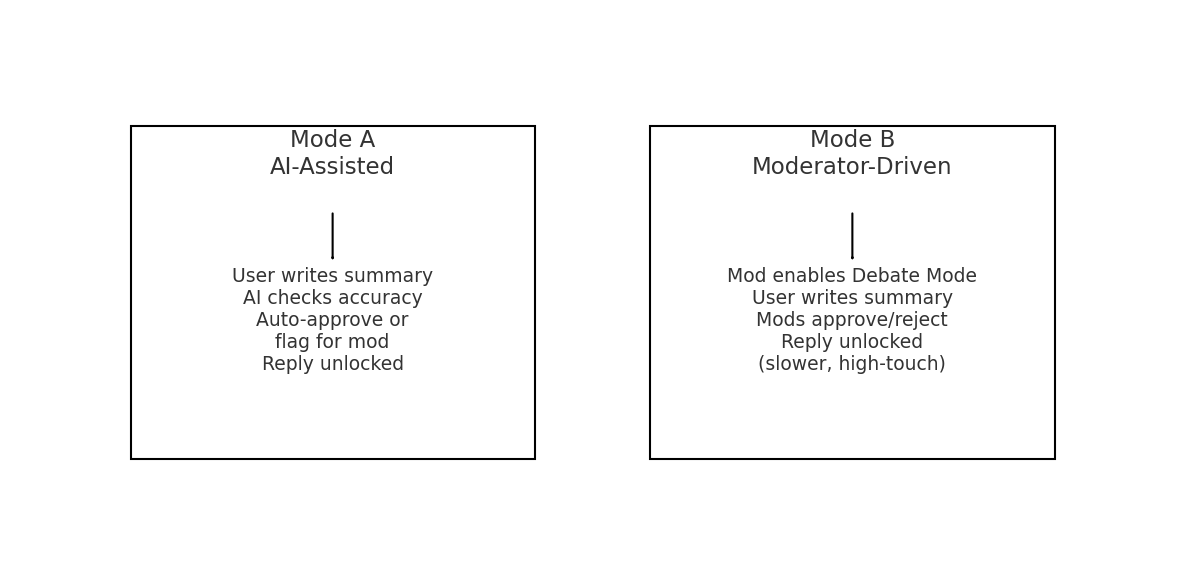
Mode A – AI-Assisted Debate Mode
- User writes a summary of the comment they want to reply to.
- The system uses AI to check whether the summary roughly matches the original.
- If it looks accurate, the reply is unlocked automatically.
- If it looks off, the summary is flagged for moderator review.
- Goal: light friction for better clarity, without overwhelming moderators.
Mode B – Moderator-Driven Debate Mode
- A moderator enables Debate Mode for a specific thread that is getting heated or messy.
- Users must submit a summary before they can reply.
- Summaries go into a moderator queue for approval or rejection.
- Any moderator can approve, reject, or attach a quick note like “you missed X”.
- The pace is slower by design, which gives space for reflection and reduces knee-jerk reactions.
Roadmap (High-Level)
- Phase 1 – Strengthen the core mechanic and add optional structure to opening claims.
- Phase 2 – Implement AI-assisted checks for summaries and basic loophole detection.
- Phase 3 – Build Moderator Mode tools for high-touch intervention in important threads.
- Phase 4 – Add transparency logs, fairness safeguards, and abuse review tools.
- Phase 5 – Prepare lightweight plugin / integration patterns for existing platforms (e.g., as a debate lane).
None of this is set in stone. The whole point is to keep the system small, strict, and experimental while it proves whether the underlying mechanic is worth the complexity it introduces.